
A landfill temporary cover—also called an intermediate cover or interim operational cover—performs a narrow but demanding job: it limits precipitation from entering the active waste mass, controls odor, and stabilizes the working face until the next lift is placed or final closure begins. A geogrids.com/product-category/geomembrane/”>geomembrane liner achieves this with a fraction of the soil thickness that a conventional cover would require. Under U.S. EPA landfill criteria, operators must control run-on, runoff, and disease vectors during the active life of the landfill [1]. A correctly specified geomembrane temporary cover supports that obligation while remaining removable and, in many cases, reusable.
The Role of Temporary Covers in Landfill Operations
Temporary covers sit between two permanent states: the daily soil cover that closes each working face and the final cover that seals a completed cell. Their purpose is to keep rainwater and snowmelt out of open or recently closed portions of the active cell. Captured stormwater becomes leachate once it contacts waste, so every cubic meter of infiltration avoided is future treatment and pumping demand avoided [1].
A geomembrane liner changes the pacing of that control. Soil alone absorbs water and erodes under rainfall; a geomembrane sheds water to the perimeter drainage system. The liner also suppresses odors, controls wind-blown litter, and deters vectors in the hours before the next waste lift arrives. Because the liner is a continuous polymer sheet, it also allows a cell to be temporarily closed for weeks or months without committing to the full cost of a final cover.
Limiting rainfall infiltration is usually the first objective of an interim cover design. Geomembrane Installation Guide: Landfill Liner Best Practices – Lianyi® covers panel layout and seam practices that keep the watertight line intact during active operations.
The design intent differs from a final cover in one important way: a temporary cover is meant to come off. That changes material choices, anchoring methods, and seam strategy. A cover that is difficult to remove can delay waste placement, damage the liner during pull-back, or force operators to cut panels that could otherwise be reused.
Choosing the Geomembrane Liner Material and Thickness
HDPE as the Primary Liner Choice
For landfill temporary covers, high-density polyethylene (HDPE) is the default geomembrane material. The polymer combines chemical resistance, stress-crack resistance, ultraviolet stabilization, and reliable weldability in a single sheet. The Geosynthetic Institute’s GRI-GM13 specification defines the minimum HDPE properties most temporary cover specifications borrow from [2].
Lianyi’s HDPE geomembrane product line illustrates the practical range: smooth or textured surface, nominal thickness from 0.75 mm to 3.0 mm, roll widths around 7 m, and roll lengths of 50 m or 100 m. Typical values include a density of 0.94 g/cm³, break strength from 20 to 80 kN/m, break elongation of 700%, stress crack resistance above 300 hours, and standard oxidative induction time of at least 100 minutes. These values are product information rather than regulatory limits; each project specification should state the required minimums explicitly.
Thickness Selection for Temporary Covers
Thickness selection starts with service life and substrate condition. For a short-duration cover over prepared waste, 1.0 mm to 1.5 mm HDPE is the most common specification range in practice. Thinner 0.75 mm sheet suits very short-term, low-traffic deployments, while 2.0 mm and above suits rough substrates, high-wear areas, or covers that may remain through an extended closure. Nominal thickness should be measured and verified in accordance with ASTM D5199 [3].
The table below summarizes typical HDPE geomembrane properties relevant to temporary covers.
| Property | Test method | Typical HDPE geomembrane values |
|---|---|---|
| Nominal thickness | ASTM D5199 [3] | 0.75–3.0 mm; 1.0–1.5 mm common for temporary covers |
| Density | — | 0.94 g/cm³ |
| Break strength | ASTM D6693 [4] | 20–80 kN/m |
| Break elongation | ASTM D6693 [4] | 700% |
| Tear resistance | ASTM D1004 | 93–374 N |
| Puncture resistance | ASTM D4833 | 240–960 N |
| Stress crack resistance | ASTM D5397 [5] | ≥300 h |
| Oxidation induction time (standard OIT) | ASTM D5885 | ≥100 min |
| Roll width | — | Typically 7 m |
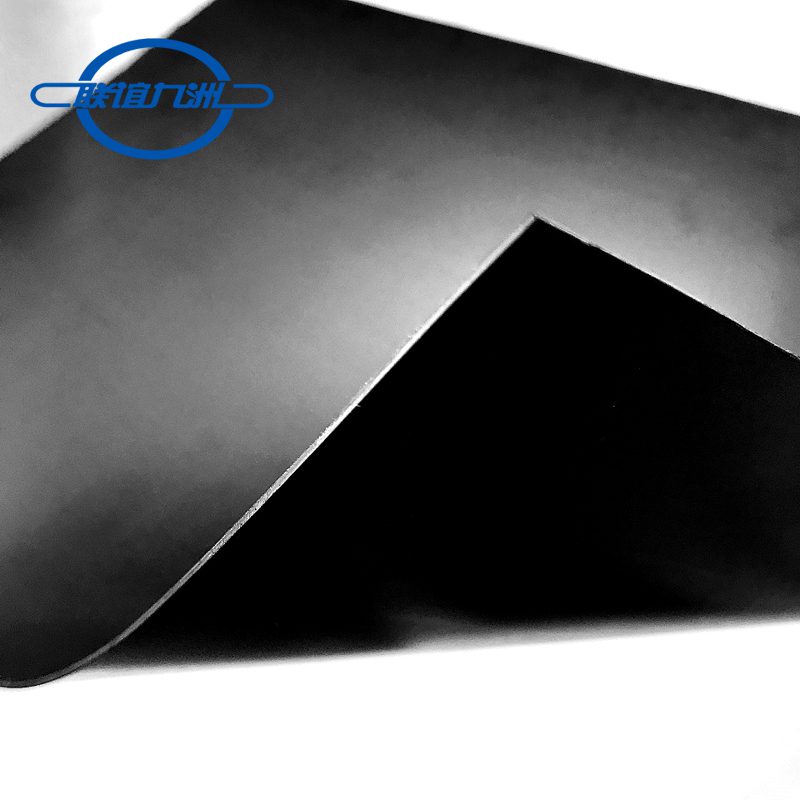
Smooth vs Textured Surface for Temporary Deployment
Surface selection is driven by slope, removal frequency, and whether the cover must support a soil veneer or ballast layer. Smooth HDPE is easier to clean, easier to fold back, and better suited to low-slope areas where the liner is held down by ballast. Textured HDPE provides interface friction on steeper slopes, which reduces the need for massive ballast and helps a shallow cover layer stay in place. GRI-GM13 covers both surface types and their property requirements [2].
For a cover that will be removed and redeployed several times, smooth sheet usually simplifies operations because debris does not lock into surface texture. On slopes where rainfall can channel and pull the liner, textured sheet or a double-sided texture detail is the safer choice. The decision should be made together with the anchorage plan, not in isolation.
Design Loads: Ballast, Anchorage, and Drainage
An exposed geomembrane cover is a large flexible sail. Wind uplift, not seepage, is often the controlling load. The design response combines perimeter anchoring, systematic ballast, and surface drainage so water never ponds deeply enough to move the liner.
Perimeter anchor trenches lock the panel edges. Surface ballast—typically sand tubes, gravel bags, or permitted tire ballast—holds the interior of each panel. Ballast spacing is project-specific and should follow the design wind speed, panel width, and slope; it should not be improvised in the field.
Surface water must be directed off the cover quickly. Low-gradient drainage swales, perimeter collection ditches, and a cushion where the liner bears on coarse waste all extend cover life. A nonwoven geotextile cushion prevents puncture from sharp waste or rock beneath the liner. Where a single combined layer is preferred, a composite geomembrane bonds the geotextile and membrane in one roll.
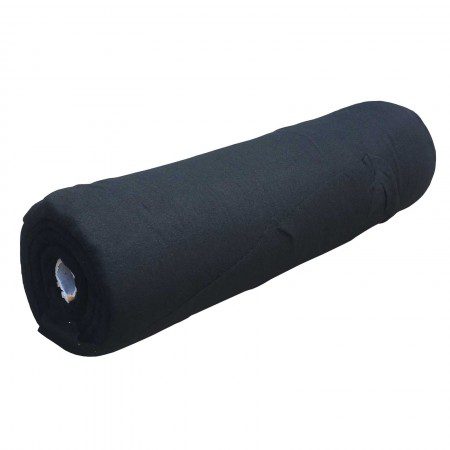
Temporary covers must shed water fast, or the water becomes a structural load on the liner. Geotextile Applications for Water and Drainage Project Success – Lianyi® covers drainage-layer selection for geosynthetic systems under moving water loads.
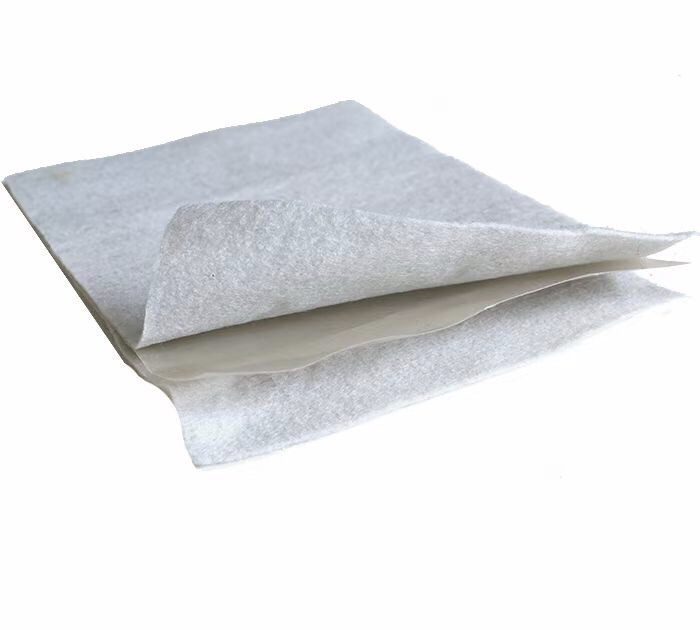
The composite geomembrane option integrates a geotextile layer with the HDPE membrane. Weights from 400 to 1,000 g/m² provide a cushioning and drainage function while reducing separate material handling during deployment.
Installation, Seam Quality, and CQA Documentation
Temporary cover installation follows the same seam discipline as permanent liner work, but with an eye toward later removal. Panel layout should be approved before deployment, with panel boundaries recorded so removal teams can cut the right seams without guessing.
Field seams are welded by hot wedge where conditions allow; extrusion welding handles patches, boots, and detail work. A trial seam starts each welding day, and destructive samples are tested in accordance with ASTM D6392 to confirm peel and shear strength [6]. Non-destructive seam testing—vacuum box, air channel, or spark testing for conductive liners—follows ASTM D4437 [7].
| Activity | Acceptance control |
|---|---|
| Panel layout vs approved drawing | CQA verification |
| Daily trial weld destructive samples | ASTM D6392 [6] |
| NDT seam testing (vacuum box / air channel) | ASTM D4437 [7] |
| Visual surface inspection before deployment | Project specification |
| Ballast and anchor placement | Design drawings |
| Repair and patch records | CQA log |
A temporary cover is only as reliable as its seams and the records behind them. Extend Geosynthetics Lifespan: Why Quality Control Matters – Lianyi® covers how factory and field QC records protect long-term liner performance.
Documentation matters because a temporary cover may be inspected and audited months after deployment. Panel numbers, seam logs, repair locations, and as-built drawings should be treated as permanent records even when the liner itself is temporary.
Planning for Removal, Reuse, and Weather
A reusable temporary cover is a logistics system, not just a sheet. Panels should be deployed along a rolling front so the newest cover is always opening in the direction work will advance. Seams are cut at marked locations, panels are folded back with equipment pads or by hand where substrate allows, and surfaces are inspected for cuts, abrasion, and UV degradation before the panel is rolled for storage.
A common working method is to divide the active cell into daily strips. Each strip is uncovered only as the next waste lift reaches it, keeping the rest of the cell sealed. The method minimizes exposed area and extends the useful life of each panel.
Weather drives both installation and removal windows. High winds make panel handling unsafe and complicate welding; rain contaminates seams and traps moisture. Lianyi’s HDPE geomembrane contains carbon black and antioxidant/UV stabilizers, which support outdoor exposure during temporary service, but the project schedule—not the polymer alone—determines how long a cover should remain deployed.
Need to specify a temporary cover system? Send your cell geometry, expected service period, and slope conditions to sales@geolianyi.com with the subject line “Temporary cover liner — specification support.” Our engineers will return thickness, surface, anchorage, and seam-testing recommendations before your next submittal.
Work With a Geosynthetics Manufacturer on Your Next Temporary Cover
Lianyi supplies HDPE geomembrane, composite geomembrane, and the nonwoven geotextiles used for cushion and drainage from the same quality system. The company operates under ISO 9001:2015, ISO 14001:2015, and OHSAS 18001:2007 management systems, with product verification through BV, SGS, and TRI. For temporary cover specifications, panel planning, or CQA support, contact sales@geolianyi.com or call +86 19153868161.
Frequently Asked Questions
What thickness HDPE geomembrane is typical for a landfill temporary cover?
In practice, 1.0 mm to 1.5 mm HDPE is the most common range. Thinner 0.75 mm sheet can work for very short-term, low-traffic covers over smooth substrates, while 2.0 mm and thicker sheet suits rough substrates or longer deployments. Verify nominal thickness per ASTM D5199 [3].
Smooth or textured—which surface works better for a temporary cover?
Smooth HDPE is usually easier to clean and redeploy, making it the default for low-slope, ballasted covers. Textured HDPE adds friction for steeper slopes and covers that must hold a shallow soil layer. The choice should follow the slope geometry and removal plan.
How are temporary geomembrane covers anchored against wind?
Temporary covers are anchored with perimeter anchor trenches, systematic surface ballast, and drainage that prevents ponding. Ballast type and spacing depend on design wind speed, slope, and panel width, and should be set by the design engineer rather than improvised in the field.
Can a temporary cover geomembrane be removed and reused?
Yes, when panels are deployed with removal in mind. Marked seam lines, protected surfaces, and a controlled unfolding sequence allow panels to be cut, cleaned, inspected, and rolled for reuse. Damage inspection should occur before the panel returns to service.
What seam tests are required for temporary cover liners?
Daily trial welds are destructively tested per ASTM D6392 for peel and shear [6]. Production seams receive non-destructive testing such as vacuum box or air channel testing per ASTM D4437 [7]. Repair patches are logged and retested.
How long can a geomembrane temporary cover remain in service?
The service period is governed by the permit, the cell schedule, and the condition of the deployed liner rather than a single fixed number. HDPE with carbon black and antioxidant/UV stabilizers tolerates outdoor exposure during temporary service, but operators should plan removal and reinspection on a defined schedule.
References
[1] U.S. Environmental Protection Agency, “Criteria for Municipal Solid Waste Landfills,” 40 CFR Part 258, Subpart F, Washington, DC.
[2] Geosynthetic Institute, “GRI-GM13: Test Methods, Test Properties and Testing Frequency for High Density Polyethylene (HDPE) Smooth and Textured Geomembranes,” Folsom, PA.
[3] ASTM International, “ASTM D5199: Standard Test Method for Measuring the Nominal Thickness of Geosynthetics,” West Conshohocken, PA.
[4] ASTM International, “ASTM D6693: Standard Test Method for Determining Tensile Properties of Nonreinforced Polyethylene and Nonreinforced Flexible Polypropylene Geomembranes,” West Conshohocken, PA.
[5] ASTM International, “ASTM D5397: Standard Test Method for Evaluation of Stress Crack Resistance of Polyolefin Geomembranes Using Notched Constant Tensile Load Test,” West Conshohocken, PA.
[6] ASTM International, “ASTM D6392: Standard Test Method for Determining the Integrity of Nonreinforced Geomembrane Seams Produced Using Thermo-Fusion Methods,” West Conshohocken, PA.
[7] ASTM International, “ASTM D4437: Standard Practice for Non-destructive Testing (NDT) for Determining the Integrity of Seams Used in Joining Flexible Polymeric Sheet Geomembranes,” West Conshohocken, PA.
If you’re interested, check out these related articles:
Geomembranes: Safeguarding Water Reservoirs and Ponds – Lianyi®
Polypropylene(PP) continuous filament non woven geotextile – Lianyi®
Geomembrane Applications for Landfill Lining Project Success – Lianyi®
Geocells: Preventing Soil Erosion with Advanced Engineering – Lianyi®
Steel Plastic Composite Geogrid 100-100kN/m – Lianyi®